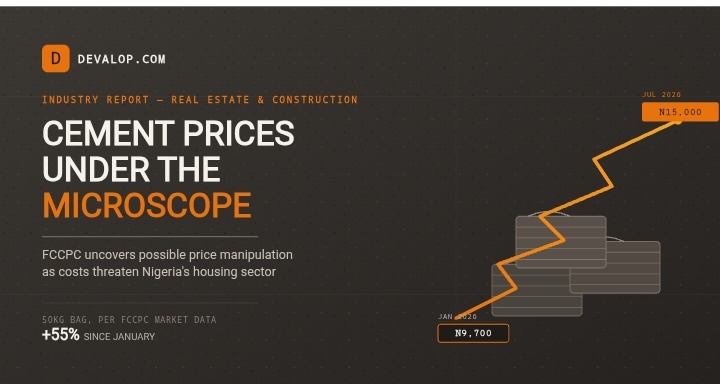

By DEVALOP.COM Newsroom | August 19, 2026 Nigeria’s Federal Competition and Consumer Protection Commission (FCCPC) has opened a formal investigation into the country’s leading cement manufacturers, including Dangote Cement, BUA Cement and Lafarge Africa, over suspected coordinated price manipulation. The announcement, made on Tuesday, August 18, has sent ripples through the real estate and construction sectors, where cement remains the single most influential input cost for housing delivery. What the Investigation Found According to the Commission, a three-month, industry-wide inquiry conducted by its Anticompetitive Practices Department produced a 40-page field report questioning why cement prices have kept climbing even though Nigeria has more than enough production capacity to meet local demand. The country’s installed cement capacity is estimated at well over 60 million metric tonnes a year, against domestic consumption of roughly 25–30 million tonnes — a surplus large enough that Nigeria is actually a net exporter of cement to neighboring countries. Despite that abundance, the FCCPC’s market intelligence showed the average price of a 50kg bag rising from about N9,300–N9,700 in January to N10,500–N13,000 by mid-year, and hitting as much as N15,000 in some locations by July. Ordinarily, such surplus capacity should intensify competition among producers and push prices down, not up — a contradiction that regulators say warranted deeper scrutiny. The Commission noted that all major manufacturers cooperated by providing records, with one notable exception. It also pointed out that three dominant players currently control more than 90% of installed cement production capacity nationwide, a concentration level that raises structural questions about how competitive the market truly is. Nigeria vs. the Region To put local pricing in context, the FCCPC widened its review to compare cement costs in Kenya, Tanzania, South Africa, Egypt, Morocco and Algeria. Its findings showed a 50kg bag selling for roughly $5.40 (about N7,344) in Kenya and $4.80 (about N6,528) in Tanzania. Even Togo, which has no limestone deposits of its own and must rely more heavily on imported inputs, recorded a price of around $6.75 (about N9,180) — still notably below Nigeria’s mid-2026 average. That gap has intensified questions about whether production costs alone can explain why Nigerian consumers pay so much more for a product the country has in abundant local supply. Regulators Push for Answers, Not Price Controls FCCPC Executive Vice Chairman and CEO, Tunji Bello, framed the probe as necessary because cement prices ripple directly into housing costs, commercial property development, infrastructure delivery and the broader cost of doing business in Nigeria. He was careful to note that the Commission isn’t trying to dictate how cement companies run their operations, but rather to determine whether the market is functioning competitively and whether ordinary consumers are actually benefiting from the country’s production strength. The FCCPC has since issued formal Notices of Commencement of Investigation and Summons to Produce to key industry players, requiring them to submit detailed information on pricing methods, capacity utilisation, export volumes and commercial relationships. The next phase of the probe will determine whether current prices reflect legitimate cost pressures or point to coordinated pricing, abuse of dominant market position, artificially restricted domestic supply, or other anti-competitive conduct. Should violations be confirmed, the investigation could pave the way for stronger regulatory intervention in an industry whose pricing decisions directly shape how much it costs to build a home in Nigeria. Notably, this scrutiny comes even as Nigeria’s three largest listed cement producers — Dangote Cement, BUA Cement and HBM Nigeria — posted strong first-half 2026 earnings, aided in part by the very price increases now under investigation, alongside higher sales volumes and a more stable foreign exchange environment. The Housing Angle: Why This Matters Beyond the Boardroom For DEVALOP.COM, this story isn’t just about corporate pricing behaviour — it’s about whether ordinary Nigerians can still afford to build. Cement is the backbone cost of construction. As one of the most heavily used materials in virtually every housing project — from single-family homes to large-scale estate developments — even modest price swings in cement translate into significant increases in overall building costs. A jump from roughly N9,500 to N15,000 per bag represents an increase of more than 50% within a single year. For a standard mid-size residential build that might require several hundred bags, that difference alone can add millions of naira to a project’s budget. The affordability gap keeps widening. Nigeria already faces a housing deficit estimated in the tens of millions of units, driven by rapid urbanisation, population growth and limited access to mortgage financing. Rising material costs compound this problem in several ways: A market structure concern, not just a cost concern. What makes the FCCPC’s findings particularly significant for the housing sector is the suggestion that price increases may not be fully explained by production costs. If cement pricing is indeed being influenced by market concentration — with a handful of firms controlling the overwhelming majority of capacity — then the problem isn’t simply “cement is expensive to make.” It’s that a market structure allowing coordinated or non-competitive pricing could be artificially inflating the cost of shelter for millions of Nigerians, even in a country producing more cement than it consumes. What resolution could mean for the sector. Should the FCCPC’s investigation confirm anti-competitive practices and lead to corrective action — whether through penalties, structural remedies, or enforced price transparency — the potential downstream effect on housing affordability could be substantial. A return to cost-reflective pricing, more in line with regional comparators like Kenya and Tanzania, could meaningfully ease construction budgets, encourage stalled projects to resume, and improve the viability of affordable housing schemes nationwide. Until then, developers, contractors and self-builders alike are left navigating a market where the cost of the most basic building block in Nigerian construction remains, in the regulator’s own words, difficult to fully justify. DEVALOP.COM will continue to monitor developments in this investigation and their impact on Nigeria’s construction and housing sectors.