
Most people know Amancio Ortega as the billionaire founder of Zara and its parent company, Inditex. But behind the retail giant lies a quiet, calculated, and remarkably aggressive strategy in a completely different sector. Through his private investment company, Pontegadea, Ortega has amassed a commercial real estate portfolio valued at over $25 billion. Today, he is not just a fashion mogul; he is one of the wealthiest private landlords on the planet, controlling prime properties across 13 countries. But the real story isn’t the size of his portfolio. It is the strict, unshakable strategy he uses to build it. Ortega’s approach completely disrupts the traditional, often flawed ways everyday investors look at property—especially here in Nigeria. Here is a deep dive into how Amancio Ortega built his real estate empire, and how smart investors can adapt his exact blueprint for structured, multi-generational wealth. Amancio Ortega Moved From A Shop Assistant to Global Billionaire Amancio Ortega’s rise is a masterclass in scale and efficiency. Born in 1936 in northern Spain, he left school early to work as a shop assistant for a local shirtmaker. By 1975, he had opened the first Zara store, pioneering the “fast fashion” model by keeping tight control over the supply chain. When Inditex went public in 2001, Ortega received a massive influx of capital. Instead of letting that cash sit idle or investing in volatile tech startups, he began channeling his massive dividend payouts into something tangible: commercial real estate. He established Pontegadea to manage this wealth. Over the last two decades, he has acquired over 200 premium properties, quietly buying up iconic skyscrapers, luxury hotels, and logistics hubs in cities like London, New York, Madrid, and Seattle. The Pontegadea Strategy: Precision and Predictability Ortega did not build a $25 billion portfolio by guessing where the market was going. His strategy is relentlessly focused on structure, risk mitigation, and predictable income. 1. Income-Producing Assets Over Speculation Amancio Ortega does not buy empty land to hold and hope it appreciates. He buys assets that are already performing. His portfolio consists of prime office towers, high-end retail spaces, and industrial logistics centers that generate immediate, massive rental income. He looks at real estate as a cash-flowing business, not a waiting game. 2. Prime Urban Locations Pontegadea focuses exclusively on central business districts and high-demand global cities. Whether it is the Royal Bank Plaza in Toronto or the Troy Block in Seattle, Ortega buys in areas where demand drastically outpaces supply. 3. Securing Blue-Chip Tenants Ortega is the landlord to some of the biggest companies in the world, including Amazon, Apple, Meta, and Spotify. By securing long-term leases with massive, stable corporations, he essentially guarantees his cash flow for decades. 4. Mathematical Rigor (IRR and DCF) At the institutional level, real estate is a game of mathematics. Ortega’s team doesn’t rely on hype. They evaluate acquisitions using stringent financial models like Discounted Cash Flow (DCF) to determine the present value of future rental income, and they strictly target assets that guarantee a high Internal Rate of Return (IRR). If the numbers do not promise steady, long-term yield, they do not buy. 5. Low Leverage is Amancio Ortega’s winning strategy Unlike many developers who heavily leverage bank loans, Ortega is known for making massive, all-cash acquisitions. By avoiding debt, his portfolio remains incredibly defensive and resilient, completely shielding him from fluctuating interest rates and market crashes. The Nigerian Market: Escaping the “Buy and Wait” Trap When we look at the Nigerian real estate market, a glaring contrast emerges. For decades, the dominant strategy here has been highly speculative. The traditional playbook is simple: Buy a plot of land on the outskirts of town, hold onto it for five to ten years, and hope the capital appreciation makes you rich. While land banking can work, it rarely creates consistent wealth because it lacks one critical component: Cash flow. An empty plot of land does not pay you at the end of the month. It is dead equity until you sell it. To build resilient wealth in today’s economy, the smartest shift an investor can make is moving away from purely speculative land-banking and toward structured, income-producing real estate. The DEVALOP Approach: Adapting the Global Blueprint At DEVALOP INNOVATIONS LIMITED and DEVALOP GROUPS, we believe that world-class wealth strategies should not be restricted to billionaires in Europe. We are actively adapting this proven, cash-flowing model to the Nigerian market. income-producing real estate in nigeria We do not just sell plots for investors to sit on. Our foundation is built entirely on three core pillars: Integrity, Innovation and Impact. We engineer our projects to reflect the same strategic rigor used by global firms to build income-producing real estate in Nigeria for our clients and investors. Our focus is clear: Structuring High-Yield Assets: We develop in high-demand, high-growth corridors where rental and commercial demand is guaranteed. Predictable Cash Flow: We create structured opportunities that allow investors to earn reliable monthly or quarterly returns, rather than waiting years for a payday. Transparent Financial Modeling: We run the numbers. By applying institutional-grade metrics to our local developments, we ensure our investors are stepping into performing assets, not speculative gambles. The Bottom Line Amancio Ortega proved that the ultimate power of real estate is not just having your name on a title deed. The real power is in structured, predictable income. The era of buying and simply hoping for the best is over. The future of wealth creation in Nigeria belongs to those who invest in assets that pay them while they sleep. Are you ready to shift your strategy from speculation to structured income? Explore our performing real estate portfolios at DEVALOP and learn how you can start earning predictable returns today.
Don’t Buy Land in Bako, Fenwa, Lade, Elenusonso Until You Read This Report
The 110-kilometer Rashidi Ladoja Circular Road is undeniably the most transformative infrastructure project in modern Oyo State history. It is designed to encircle the Ibadan metropolis, ease traffic, and unlock massive economic corridors. As a result, there is a fierce real estate rush in Ido Local Government Area—specifically in rapidly emerging hubs like Bako, Fenwa, Lade, and Elenusonso. But behind the promise of massive returns lies a dangerous trap for the uninformed buyer. Before you sign any deed of assignment or transfer any funds for land in Bako, Fenwa, Lade, Elenusonso, Ologuneru, or close proximity to these areas, you must understand the strict government acquisition boundaries and the critical disclaimers that dictate the future of these lands. The 150-Meter vs. 500-Meter Trap: What You Must Know About Bako, Fenwa, Lade, and Elenusonso axis The most critical disclaimer in the Ido axis right now revolves around the official Right of Way (RoW) and the setback limits. Ignorance of these metrics is the fastest way to lose an investment. The Original Baseline: The initial acquisition, initiated in 2005, mandated a 75-meter setback on each side of the road, totaling a 150-meter corridor. The Masterplan Expansion: To create the “Ibadan Circular Road Corridor Urban District”—a smart city integrating residential, commercial, and industrial zones—the setback was legally expanded to 500 meters on each side (a 1-kilometer total corridor) under the Oyo State New Towns and Cities Development Authority (OYNTCDA). The Recent Concession: Following community outcry, the state government recently made a critical concession: The 150-meter limit will be maintained for clearly built-up, developed areas. However, for undeveloped lands, the full 500-meter acquisition strictly applies. The Danger: Unscrupulous sellers in Bako or Lade might sell you a vacant plot 300 meters from the road, citing the “150-meter concession.” If that land is undeveloped, it legally belongs to the government’s 500-meter future development zone. Mastering the Velocity of Wealth in Fenwa, Lade or Elenusonso Smart real estate investment is a race against inflation and market timing. Mastering the velocity of wealth requires a deep understanding of the time value of money in real estate. When you purchase property in the safe zones of Fenwa or Elenusonso—just outside the 500-meter government acquisition line—your asset begins to compound in value immediately as the road construction nears completion. The infrastructure acts as a catalyst, accelerating your return on investment. Conversely, buying land tied up in government acquisition disputes drops the velocity of that investment to zero. Funds trapped in demolition threats or protracted compensation battles lose their time value, severely stalling your financial momentum. You want assets that accelerate wealth, not liabilities awaiting the bulldozer. Achieving True Ownership: The Ultimate Disclaimer Buying land in these high-stakes corridors demands more than just exchanging money for a receipt. Achieving true ownership is akin to entering a blood and land covenant—a permanent, generational transfer of rights that must be legally unassailable. A family receipt (from the Omo-Onile) does not secure this covenant if the land overlaps with the state’s industrial masterplan. To protect your capital and build sustainable homes and properties, you must adhere to the following investor disclaimers: Demand a Registered Survey: Never buy based on physical estimations. Ensure the coordinates are charted at the Surveyor-General’s office to confirm the land sits firmly outside the 500-meter OYNTCDA corridor. Beware the “It Will Be Excluded” Myth: Do not buy land inside the acquisition zone based on verbal promises that the government will eventually pardon the area. Align with the Industrial Blueprint: Ido Local Government is projected to be the industrial and logistics engine of the new Ibadan. Position your investments strategically to benefit from this economic spillover without encroaching on the state’s designated light industrial clusters. Conclusion on Lands in Bako, Fenwa, Lade, and Elenusonso… The areas of Bako, Fenwa, Lade, and Elenusonso offer some of the most lucrative real estate opportunities in South-West Nigeria today. However, the line between a generational asset and a total loss is drawn by the government’s setback coordinates. Verify before you buy, engage certified professionals, and ensure your investment is built on legally safe ground.
Ibadan Real Estate Market Forecast 2026
Why “Vibes” Are Killing Your Real Estate Business (and What Top Performers Do Differently)
The Invisible Gap in the Nigerian Market The Nigerian real estate market is currently bifurcated. On one side of the divide, you have the realtor perpetually “looking for the right deal,” struggling to maintain consistency in a volatile landscape. On the other side, you find the high-performers: the developers who sell out projects off-plan before the first brick is laid, and the investors who quietly stack properties while others are still debating market conditions. The difference between these two groups is rarely a matter of raw talent or luck. The central problem is that the vast majority of Nigerian real estate professionals operate on “vibes”—a reactive, “let’s see what happens” mindset—rather than a documented system. To bridge this gap, you must move beyond the amateurism of “winging it” and transition onto a Strategic Fast Track. This is not just a shift in mindset; it is a shift toward a structured, training-based approach to business. The Death of “Operating on Vibes” Success in the local market is not a roll of the dice; it is the result of deliberate architecture. While many believe that top-tier results come from being a “natural” at sales, high-level performance is actually a product of specific training and rigorous planning. Relying on intuition or “vibes” is a recipe for professional burnout because it lacks predictability. When you operate without a plan, you are forced to reinvent your process every morning, which leads to exhaustion and ultimate stagnation. “While most people in the Nigerian real estate space are operating on vibes and ‘let’s see what happens’ the ones who are winning have a plan.” The Architecture of a Self-Sustaining Lead Engine A primary pillar of business growth is the implementation of an inbound lead generation system that functions independently of the entrepreneur’s manual intervention. Most realtors spend their lives “chasing” clients—a cycle that is not only exhausting but impossible to scale. By building a system designed to attract and qualify leads automatically, your role shifts from a “hunter” to a “business architect.” Instead of wondering where the next transaction will come from, you focus on managing the marketing infrastructure that delivers those prospects. This allows the business to maintain momentum even when you aren’t personally pounding the pavement. Conversion Mastery: Closing Without the Chase Top performers do not leave their closings to chance; they use specific frameworks to move conversations forward. Scaling a real estate business is an exercise in futility if every deal requires a unique, unrepeatable miracle to close. To eliminate guesswork, professionals must adopt a “what to say” framework that guides a prospect through a pre-determined psychological journey. This repeatable process ensures that every interaction has a strategic purpose and a clear path toward a resolution. When the strategy does the heavy lifting, you can handle a higher volume of transactions without the typical “chase” that leads to sales fatigue. Building for Equity: Sustainability Over Monthly Survival There is a fundamental difference between surviving “month to month” and building a sustainable business. A “job” in real estate—the vibes approach—stops paying the moment you stop moving. Conversely, a “business” is a structured asset that produces predictable cash flow and holds equity. True sustainability requires a transition from working harder to working smarter. It means replacing the “hustle” with a structure that produces consistent results regardless of your daily activity level. “You don’t need to work harder. You need to work smarter.” Conclusion: Your Move Toward the Fast Track Adopting a system is the single most important factor in changing the trajectory of your career. By replacing guesswork with strategy and “vibes” with a lead engine, you stop merely having a job and start owning a business that works for you. The path to this level of operation is through DEVALOP REAL ESTATE STRATEGIC FAST TRACK COURSE. This is where the “winging it” ends and the building begins. The next cohort is opening soon, but spots are limited to ensure high-level engagement. Are you building a business that works for you, or have you just created a job that requires you to chase “vibes” forever? The choice to move to the Fast Track is yours. Don’t wait until the market leaves you behind—secure your spot before the cohort fills up.
Building a Legacy of Prosperity: Happy New Month!
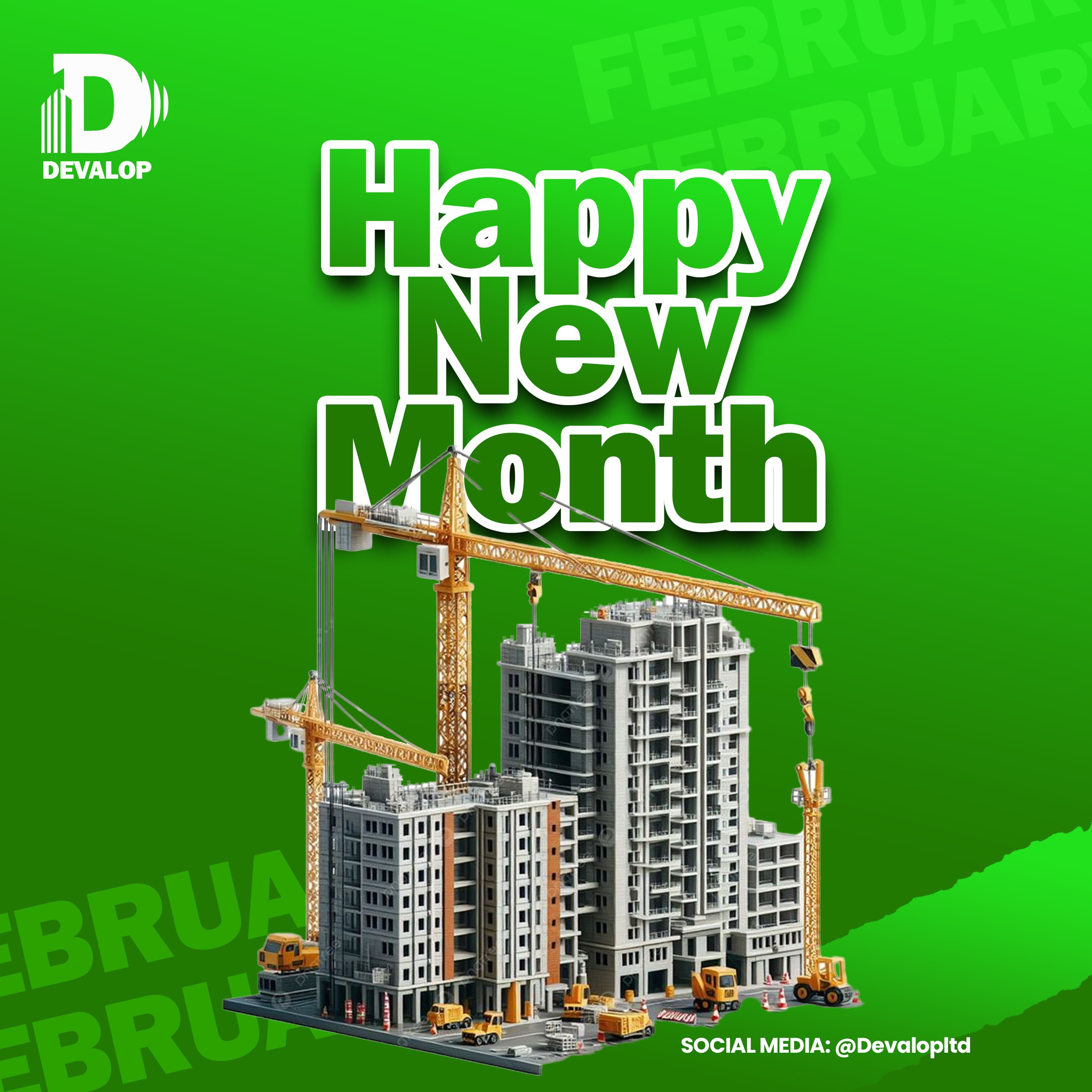
Welcome to February! At DEVALOP, we believe that every new month is a fresh foundation upon which to build your dreams. As the cranes swing and the structures rise, we are reminded that progress isn’t just about steel and concrete—it’s about the people and the futures we are helping to create. Whether you are looking to invest, develop, or find your forever home, this month offers a clean slate to turn those “someday” plans into “today’s” reality. Start Your Week on Solid Ground They say how you spend your Monday sets the tone for the rest of your week. We say: Why just have a “good” week when you can have a prosperous one? Real estate is more than just property; it’s a pathway to long-term financial security. Our team is already on-site and in the office, fueled by our core values of Innovation, Integrity, and Impact, to ensure your investments are handled with the excellence they deserve. “Prosperity is built one brick, one decision, and one Monday at a time.” Join the DEVALOP Community Don’t miss a single update on our latest projects and investment opportunities. Connect with us across our social platforms: Let’s make February a month of groundbreaking success! About DEVALOP INNOVATIONS LTD At DEVALOP, we are more than just a real estate company; we are architects of progress and partners in your prosperity. Driven by our core pillars of Innovation, Integrity, and Impact, we specialize in delivering world-class real estate solutions that stand the test of time. Led by our MD/CEO, Olawale Daniel, our team is committed to bridging the gap between vision and reality. Whether through strategic property development, investment consultancy, or land acquisition, we ensure that every brick laid contributes to a legacy of “True Ownership.” At DEVALOP, we don’t just build houses—we develop the future.